The Solo Woman’s Hotel Safety Checklist: Simple Steps for Peace of Mind

Safety Is the Foundation of Freedom
I want to be honest about something before we start: I almost didn't write this piece.
I have traveled alone since my mid-twenties. For work first, and then for pleasure, and then — after my son graduated — for something I can only describe as reclamation. Solo travel is not something I think about anymore. The systems are so embedded I don't notice them. They're just what I do.
But I remember the women I've met on the road who were doing it for the first time at fifty-two, or sixty, or sixty-seven. Women who had spent thirty years negotiating every trip around someone else's schedule and were now, finally, alone in a city they had always wanted to see — and absolutely terrified. Not of anything specific. Of the general fact of being alone in the world without a net.
That fear is real and worth addressing directly. What is second nature to me was new to them. This is for them.
Before You Book: Do the Research
Most safety advice starts with the hotel room. I start earlier than that.
Before I book anything — hotel, Airbnb, apartment rental — I read every review. Not for the breakfast situation or the thread count. I read them for what people say about the neighborhood. I want to know what it felt like to walk back at night. I want to know if a woman traveling alone felt uncomfortable. I want to know where the nearest pharmacy is and whether the street is lit.
On Airbnb especially, I read the comments the way I read a city — looking for what's not being said as much as what is. A listing with a hundred reviews and not one mention of the surrounding area tells me something. So does a review that calls the neighborhood up and coming. I know what that means.
Use the street view function on digital maps and walk the block virtually before you commit. Look for nearby cafes, pharmacies, open businesses. A good deal on a dark, deserted street is not a good deal. You will spend the whole trip calculating your walk home.
This is where your safety plan actually begins. Not with the doorstop. With the hour you spend before you book, deciding whether this is a place you can move through comfortably and alone.
Before You Leave Home
Get travel insurance. I know it sounds like advice nobody takes. Take it anyway. A medical emergency in a foreign country, alone, without coverage, is not something you want to improvise your way through.
Request a higher floor. It puts natural distance between you and street-level access, and it costs nothing to ask.
The Lie
Say this plainly and without apology: lie to strangers.
If someone you don't know asks whether you are traveling alone, the answer is no. Always no. My son is upstairs. My husband is meeting me for dinner. My friend just went to get coffee. This is not paranoia. A stranger who asks you immediately and directly whether you are alone is already a reason to be alert.
Some women talk loudly into their phone walking back to the hotel at night — Hey, I'm in the taxi, I'll be there in ten minutes — whether or not anyone is on the other end. The performance of being accompanied is one of the most effective tools you have. Use it freely and without guilt.
One important distinction: this is for strangers, not hotel staff. The front desk needs accurate information — they are also your first line of help if something goes wrong. Don't complicate that relationship with a story that a single passport will immediately contradict.
Check-In
You are tired. You have luggage. You want to get to the room. This is the exact moment to stay alert.
If the clerk announces your room number out loud, ask to be moved and have it written down instead. It takes five seconds. Your room number is not public information.
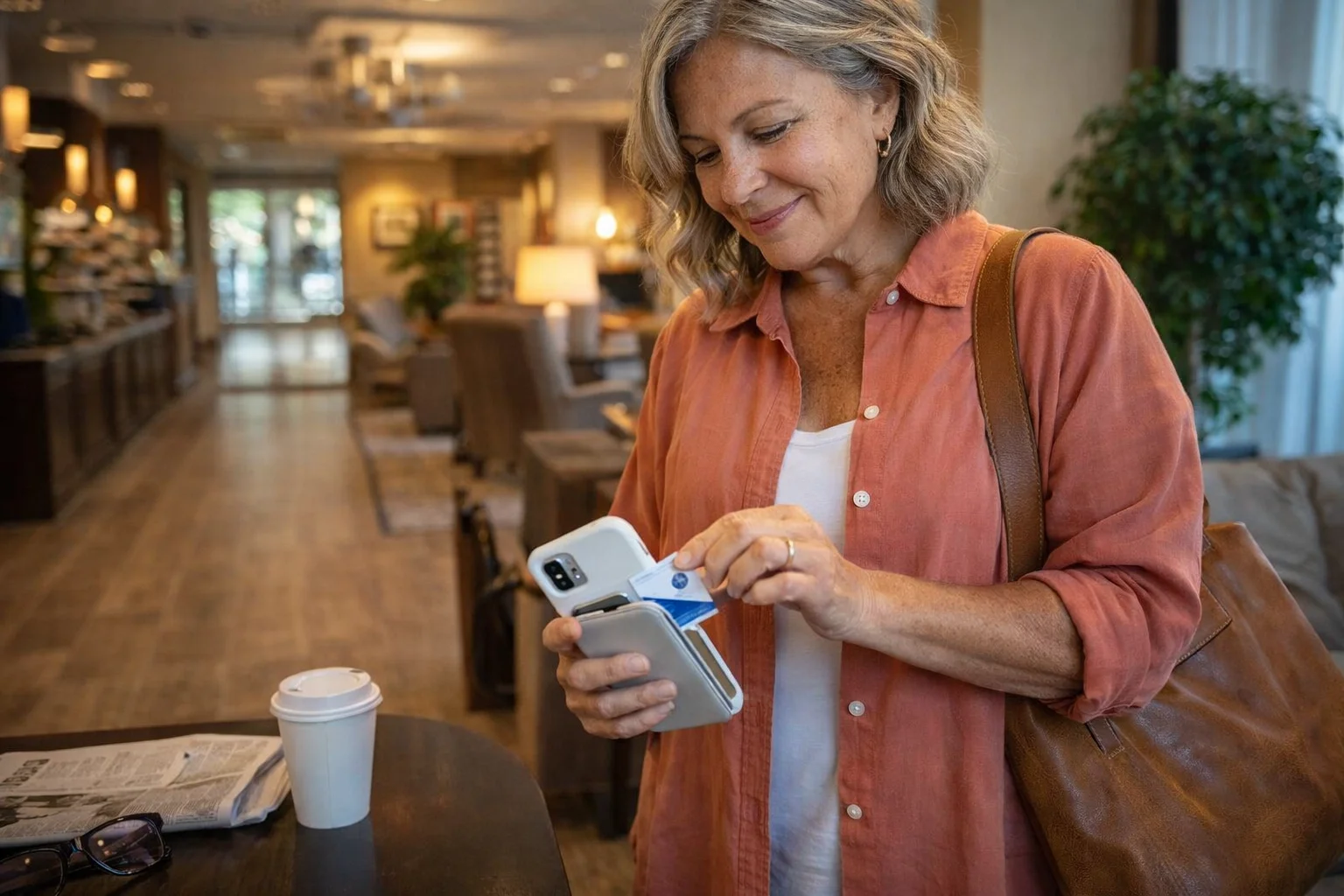
Ask for two keys — no explanation needed. Grab a business card with the hotel's address and tuck it into your phone case. If your phone dies while you are out — and eventually, it will — you have the address in your hand to show a driver.
The Room
Go straight to your room. If someone gets on the elevator with you and something feels off, press a different floor and wait.
When you enter, leave your bags at the door and sweep the room before you unpack. Check the closet, behind the shower curtain, under the bed. Check the locks on the door and any connecting door to an adjacent room. Check the windows and balcony. If a lock is broken, call the front desk and ask for a new room. You are claiming the space.
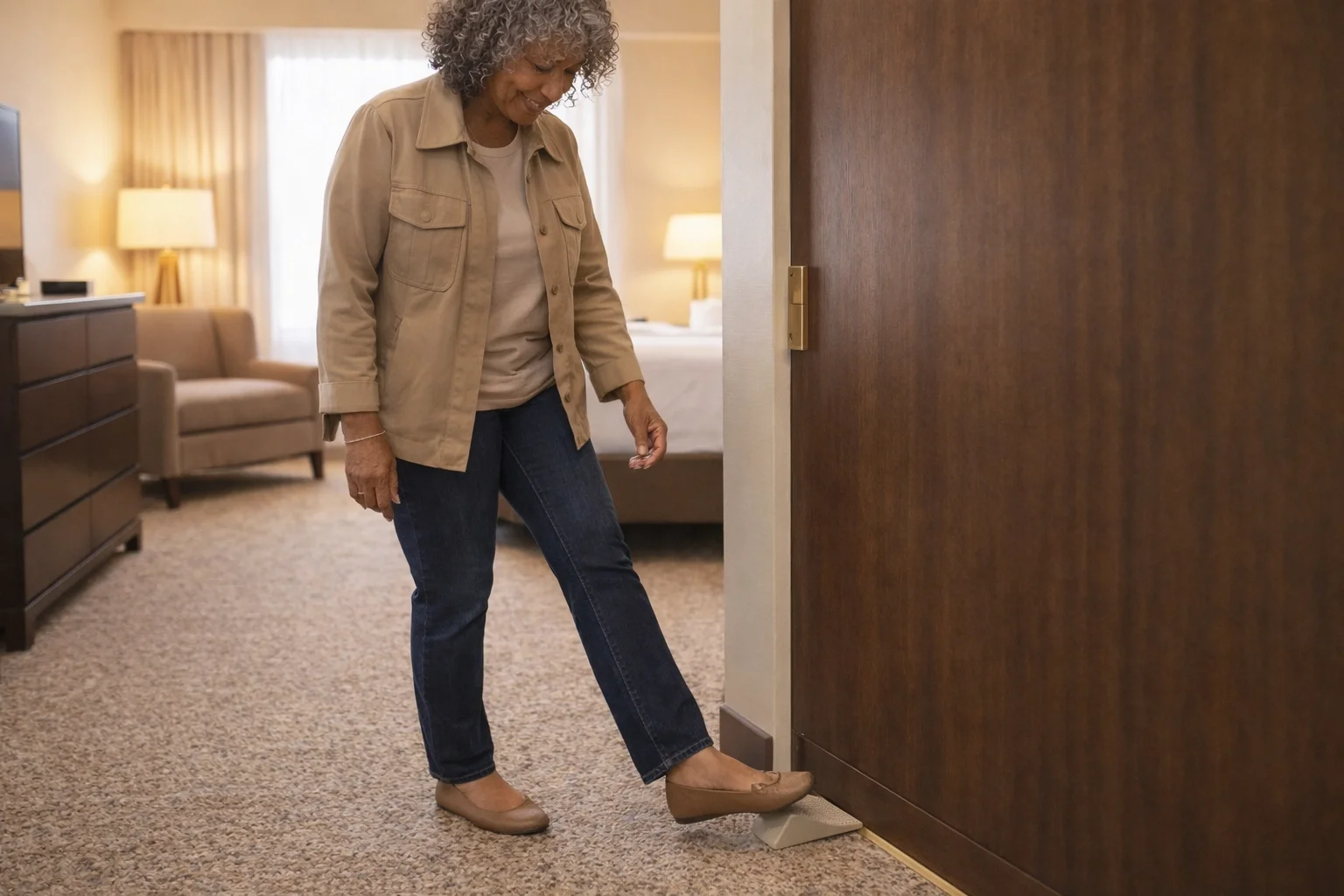
Some women travel with a rubber doorstop — wedged under the door at night so that even a master key can't push it open. Others prefer a portable door lock, which is harder to defeat and easier to pack. I'll link to one worth having below. Either way, the principle is the same: a mechanical backup lets you sleep.
Keep the Do Not Disturb sign on the door at all times, even when you're out. Leave the television on at low volume when you leave for the day. Small things. They add up.
If someone knocks claiming to be room service, maintenance, or housekeeping and you weren't expecting anyone, call the front desk before you open the door. Did you send someone to room 412? If you did order room service and something about the situation makes you uncomfortable, ask them to leave the cart outside. You are not obligated to let a stranger into your room.
Out in the City
Carry a crossbody bag and keep it close. Most of what goes wrong for women traveling alone is not dramatic — it is petty theft, and petty theft is a crime of opportunity. Stay aware of your surroundings and you become a less convenient target. That is usually enough.
Arrange transportation to and from the airport before you arrive. Use app-based ride services when you can — they create a record of your trip, including the driver and vehicle. Don't hail a random car on the street, especially at night.
When you need help from a stranger, find a woman — preferably one with children or other women nearby. This is not a slight on anyone. It is just pattern recognition.
We are conditioned to be polite. We are taught to override our instincts rather than cause discomfort. When you are traveling alone, set that conditioning aside. If a situation feels wrong, leave it. You don't owe anyone an explanation. Your gut is processing information before your conscious mind catches up. Trust it.
Keep your wits available. There is a difference between a glass of wine with dinner and drinking until your judgment is compromised in a city you don't know, alone.

8 Things That Will Make You Safer
Research the neighborhood before you book — read what women say about walking back at night
Get travel insurance before you leave home
Request a higher floor
If a clerk announces your room number, ask to be moved and have it written down
Use a doorstop or portable door lock at night
Carry a crossbody bag and stay aware of your surroundings — petty crime is a crime of opportunity
Never confirm to a stranger that you are traveling alone
Trust your gut without apology — if something feels wrong, leave
The world is kinder than the news would have you believe. Most people are helpful. Most hotels are safe. But the confidence to actually see that — to take in a city instead of calculating risk — comes from knowing you have already handled the handling.
You are your own best protector. You always have been.
If you're ready to plan your first solo trip and want help with the logistics, the Solo Travel Starter Kit is where to start.
